

By Lam Legal | Reviewed by Ada P. Lam
Short Answer
Business litigation in British Columbia can take anywhere from a few months to several years. The timeline depends on things like how complicated the dispute is, how many parties are involved, how much evidence needs to be reviewed, and whether the case is amendable to a negotiated settlement or goes to trial.
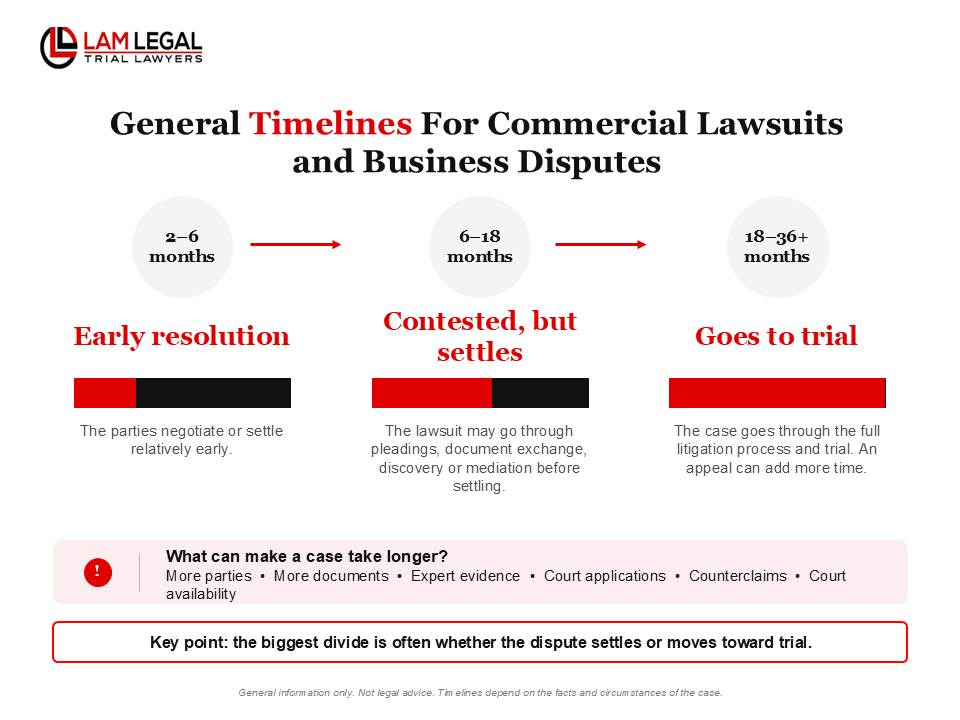
A relatively straightforward dispute might be resolved in 2 to 6 months. A contested case that eventually settles could take 6 to 18 months, while a case that goes all the way to trial may take 18 to 36 months or longer, especially if there is an appeal.
Less than 1% of commercial cases actually proceed to a trial or an appeal though, especially when there are experienced lawyers acting for both parties.
How Long Does Business Litigation Take In BC?
“How long will this take?” is one of the first questions business owners ask us about litigation. And we can certainly understand why.
A lawsuit creates uncertainty. It costs money, takes up management time, and makes it harder to plan ahead. Most of us would prefer a fixed timeline so we can budget for the dispute and know when we can put it behind us.
We wish we could give clients a firm timeline, but business litigation rarely works that way. How long a case takes depends on the issues in dispute, the amount of evidence involved, the court’s availability, the number of parties, the temperament of the opposing parties or lawyer, and how the parties approach the litigation. A case that settles relatively early can look very different from one that goes through discovery, applications and ultimately a trial.
The Supreme Court Civil Rules are intended to help cases proceed toward a “just, speedy and inexpensive determination.” But in practice, business litigation can still take months or even years, depending on the case. No lawyer can tell you at the beginning of a case exactly how long that process will take. If anything, the business owner may be in a better position to assess this because they have a better understanding of the opposing party’s ire, temperament and how important the issues at risk are for them.
An opposing party who is arguing from the standpoint of principle on an issue that affects their personal or company’s reputation is quite different from an opposing party who also wants to put this dispute to bed.
Sometimes, with unruly parties, it can take a court application or lawsuit to “pin the tiger to the ground”, and get them to focus on what is actually at risk, what their actual interests are at play here – and resolve the matter with you in a more rational way.
However, below, we try to explain the other factors that tend to make business litigation shorter or longer, and give you a realistic idea of what the process may look like.
What “Business Litigation” Actually Includes
Business litigation in British Columbia covers a wide range of disputes, including:
- breach of contract
- partnership disputes
- shareholder oppression and shareholder disputes
- fiduciary duty claims
- commercial lease disputes
- debt recovery and unpaid invoices
Depending on the nature and value of the dispute, the matter may proceed as a civil claim or civil lawsuit in the Provincial Court or Supreme Court of British Columbia.
Some business disputes simply take longer than others. A straightforward debt recovery case might be resolved fairly quickly. A shareholder oppression claim, on the other hand, may involve more evidence, more parties (and generally speaking, heated parties) and additional court applications.
That’s why there isn’t one standard timeline for every business lawsuit.
Typical Timeline Ranges
While every case is unique, the following realistic ranges reflect common experience in BC business litigation:
- Early negotiated resolutions: approximately 2 to 6 months
- Contested but settled cases: approximately 6 to 18 months
- Cases proceeding to trial: often 18 to 36 months or longer
- Appeals: may add 6 to 18 months or more
These are not guarantees. Actual timelines depend on many interacting factors. Trials and appeals are extremely uncommon in experienced hands though, as our lawyers can narrow the issues or resolve the matter through other means.
How Long Different Business Disputes Can Take
The type of dispute can make a big difference to the timeline. Here’s a general idea of how long some common business disputes may take in BC.
Breach of Contract
Breach of contract cases can take anywhere from 6 to 24 months. A lot depends on how much evidence there is, what facts the two sides disagree about, and whether experts need to get involved. Trials, which are extremely rare, will be on the longer end, while negotiated settlements will be on the shorter end.
Partnership Disputes
Partnership disputes can take 12 to 36 months or longer. These cases can get complicated, especially when there are disagreements over money, accounting records, shareholder agreements or partnership agreements, possible fiduciary breaches, business relationships, or what each partner was supposed to contribute to the business. Trials, which are extremely rare, will be on the longer end, while negotiated settlements will be on the shorter end.
Shareholder Oppression and Derivative Actions
Shareholder disputes and oppression claims can take 18 to 36 months or longer. They often involve a lot of records, several people or companies, and court applications that need to be dealt with before the main dispute is resolved. Trials, which are extremely rare, will be on the longer end, while negotiated settlements will be on the shorter end.
Fiduciary Duty Claims
Fiduciary duty claims can also take 12 to 36 months or longer. These cases often require a close look at what happened, who owed duties to whom, and whether anyone suffered a financial loss that could support a claim for monetary compensation or other relief. Trials, which are extremely rare, will be on the longer end, while negotiated settlements will be on the shorter end.
Commercial Lease Disputes
Commercial lease disputes often take 6 to 24 months. A relatively straightforward dispute over unpaid rent may move faster, while disagreements over what a lease means or how much one side owes can take longer. Arbitrations are also sometimes used in commercial lease disputes to move matters along faster. Trials, which are extremely rare, will be on the longer end, while negotiated settlements will be on the shorter end.
Debt Recovery Lawsuits
Debt recovery actions can sometimes be resolved in 2 to 12 months if the debt is clear and the other side does not seriously dispute it. If the defendant raises a defence or counterclaim, though, the case can take much longer.
Key Factors That Affect How Long a Case Takes
Several factors significantly affect timelines:
- Dispute complexity: more complex legal or factual issues require more time
- Number of parties: additional parties increase procedural steps
- Counterclaims: add complexity and length
- Document volume: large productions slow discovery and preparation
- Expert evidence: requires time for reports and challenges
- Court availability: trial dates are often scheduled far in advance
- Party conduct: missed deadlines, incomplete disclosure, strategic delay, or unreasonable instructions from either side can extend proceedings. Sometimes a lawyer also needs to help their own client step back from positions driven more by emotion or principle than by the practical interests of the business.
What You Can Do Early On
Getting legal advice early can sometimes help keep a dispute from dragging on longer than it needs to. That can mean figuring out the main issues sooner, making sure important evidence is preserved, and having a clearer strategy from the start.
It also helps to get your relevant documents organized early. Missing records, slow responses, or waiting too long to deal with a problem can all create delays. Also, you want to avoid missing periods, which will put the claim itself at risk.
Settlement Discussions Can Make a Big Difference
99+% of business disputes do not end in a trial.
A case might settle after the lawsuit has started, during discovery, through mediation, or even shortly before trial. The earlier the parties can reach a workable resolution, the less time they usually spend going through the full court process.
Mediation and other alternative dispute resolution methods can sometimes help because they give both sides a chance to focus on a practical solution instead of continuing the fight.
At all points, negotiations are engaged where appropriate to try to resolve the dispute.
Trials are generally reserved for cases where there are genuine issues in dispute that the lawyers cannot resolve through negotiation or another form of dispute resolution, leaving a judge to decide those issues. A matter may also be more difficult to resolve when a party is unrepresented and does not have a lawyer advising them about the risks of continuing, including the possibility of spending significant time at trial and being ordered to pay part of the other party’s court costs.
Pre-Lawsuit Negotiations Can Resolve a Dispute Before Court
Before a lawsuit is filed, lawyers will often send demand letters and negotiate with opposing counsel. These communications can set out the relevant evidence, the legal basis for the client’s position, and why the client is likely to succeed if the dispute proceeds.
These pre-lawsuit negotiations can work. In some matters, the parties are able to reach a practical resolution and the business owners can get out of the dispute without ever starting the court process, which is often the outcome clients want.
What Happens Before a Business Case Reaches Trial?
The legal process for a business lawsuit can go through several stages before it ever gets to trial, including:
- pre-lawsuit negotiations, including demand letters and lawyer-to-lawyer discussions aimed at resolving the dispute before a claim is filed
- pleadings, which involves the formal filing of lawsuits or your response to an opposing party’s lawsuits
- discovery, where the opposing parties’ obtain documentation and oral evidence from the parties to support or defend their cases
- court applications
- mediation or another form of dispute resolution
- trial preparation
- trial
There can be delays at almost any point. The parties may need more time to exchange documents, lawyers may need to schedule court applications, or the court may not have an early trial date available.
Why Delays Matter
The longer a business dispute goes on, the higher the legal costs can become.
Delay can also make the case harder to manage and more time consuming. Memories fade, documents can become harder to track down, and the dispute can continue taking time away from the business.
In extreme cases, a court can even dismiss a claim if there has been a serious and unexplained delay in moving it forward.
What You Can (and Can’t) Control
You cannot control everything about the timeline. You cannot decide how quickly the other side responds or whether they are being unreasonable, and you cannot control when the court has dates available.
But there are things you can do to help keep the case moving. That includes getting your documents organized, responding promptly when information is needed, and being open to settlement discussions when they make sense.
That still does not give you a fixed timeline, but it can help avoid unnecessary delays.
Why We Can’t Give You an Exact Timeline
Every business dispute is different, so no article or lawyer can tell you exactly how long your case will take at the outset.
What we can do is look at the type of dispute, the evidence involved, the legal issues in dispute, the number of parties, and whether settlement is realistic to give you a better sense of what to expect.
What Different Timelines Can Look Like
Here are a few examples of how business litigation timelines can vary:
- A relatively quick case: an uncontested debt recovery matter might be resolved in 2 to 4 months.
- A mid-length case: a breach of contract dispute that settles after discovery might take 9 to 15 months.
- A longer case: a shareholder oppression dispute involving several parties with a trial could take 30 months or more.
Frequently Asked Questions
Key Authorities
- Zhong Tie Enterprise Inc. v. Topcorp Development Inc., 2024 BCSC 224
- Soltani v. Fadaee, 2022 BCSC 2163
- Kyle v. Zimmer, 2024 BCSC 500
Legislation
- Supreme Court Civil Rules, BC Reg 168/2009
Questions about a business dispute in BC? Book a Free Discovery Call or call 604-800-0774 to discuss your situation with Lam Legal Trial Lawyers.
This article provides general legal information only and is not legal advice. Every business dispute depends on its particular facts and circumstances.