


By Lam Legal | Reviewed by Ada P. Lam
Let’s say you’re owed a lot of money under a contract.
The other side refuses to pay, negotiations go nowhere, and eventually you’re thinking about court. Your claim may be strong, but there’s another question that’s just as important: If I win, does the other side have to pay my legal fees?
The answer is only partly.
In British Columbia, the unsuccessful party in a lawsuit will generally be ordered to pay some of the successful party’s legal costs. But those costs usually cover only a portion of the lawyer’s actual bill.
That difference can have a significant impact on whether it makes financial sense to start, defend or settle a business dispute.
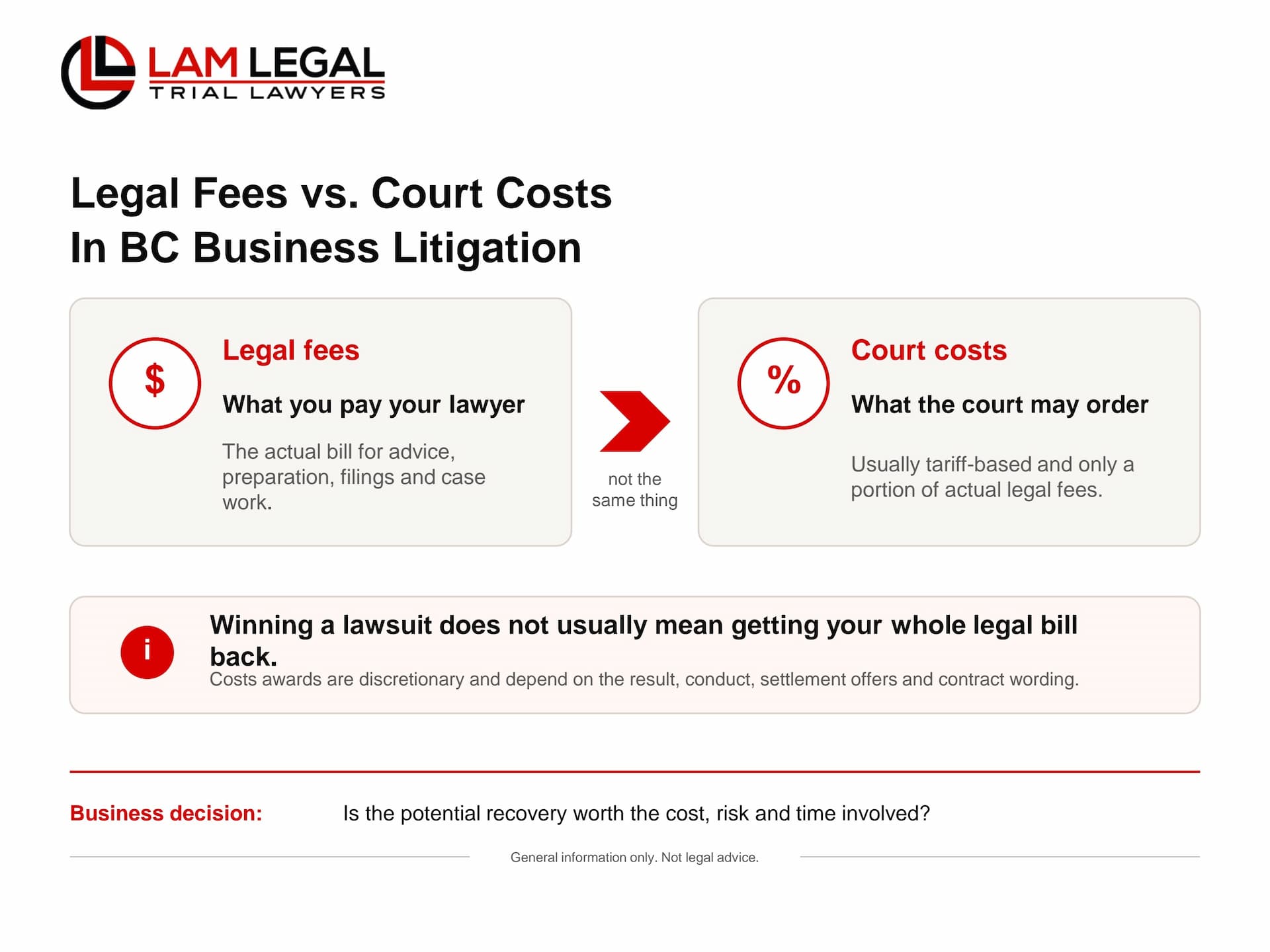
Legal fees and court costs under the Supreme Court Rules
People often think “legal fees” and “costs” are one and the same, but they actually mean different things in litigation:
-
Legal fees are what you pay your lawyer for the work they perform on your case.
-
Court costs, usually referred to simply as “costs,” are amounts the court may order one party to pay the other. They are intended to reimburse part of the successful party’s litigation expenses.
In BC Supreme Court, these costs are generally calculated using the standardized cost schedule set out in Appendix B of the Supreme Court Civil Rules. They are not calculated by looking at the amount you actually paid your lawyer for legal services. Where a tariff item allows a range of units, the maximum number may apply to matters involving a great deal of time spent on that step.
As a result, winning a lawsuit does not usually mean recovering your entire legal bill.
Lam Legal generally advises clients that tariff costs may cover roughly 22 to 28% of their actual legal costs, although the amount will depend on the case and the steps taken during the litigation.
This article focuses on business disputes in BC Supreme Court under the Supreme Court Civil Rules. Different rules may apply in Provincial Court, or in a family law case governed by the Supreme Court Family Rules. Other areas of civil litigation, including estate litigation, may also involve different considerations when costs are awarded.
Who is normally awarded costs in a business lawsuit?
The general rule in BC Supreme Court is that costs follow the event. In plain English, that usually means the loser pays some of the winner’s legal costs.
Say a business sues a customer or supplier for breach of contract and wins. The business may receive damages, plus an award for some of its legal costs and reasonable disbursements.
But the rule cuts both ways. If the defendant wins, the plaintiff may have to pay some of the defendant’s costs instead. If a plaintiff discontinues an action, they may have to pay the other party’s costs up to the date the notice of discontinuance is served, and later proceedings involving substantially the same claim may be stayed until those costs are paid.
Judges still have discretion when making an order for costs, though. They may take into account things like:
-
how the parties behaved during the case;
-
whether reasonable settlement offers were made or rejected;
-
whether each side won on different key issues; and
-
the circumstances of the case as a whole.
So even if you win, you should not assume the other side will automatically be ordered to pay your costs.
What do court costs (BC) cover?
A typical costs award has two main components.
The portion of your lawyer’s fees the other side may have to pay
Party-and-party costs is the portion of the winning party’s legal costs that the court may order the losing party to pay.
They’re calculated based on the standardized cost schedule set out in the Supreme Court Civil Rules. The amount depends on factors such as the litigation steps taken and the complexity of the case. Because the cost schedule does not mirror a lawyer’s actual hourly fees, these awards usually reimburse only part of the successful party’s legal expenses.
Other expenses you may be able to recover (disbursements)
Disbursements are expenses paid to third parties as part of the case, such as:
-
court filing fees;
-
expert reports;
-
service and witness fees;
-
photocopying costs and document production costs; and
-
other necessary out-of-pocket expenses.
Reasonable and necessary disbursements may generally be recovered in addition to tariff costs. Self represented litigants may also be able to recover eligible disbursements. Expert fees may also be recoverable if the expert evidence was reasonably necessary for the case. Bring receipts for disbursements to the taxation hearing. A taxation hearing determines the actual amount of costs awarded.
What happens if both sides win something?
Business litigation does not always produce a clear winner and loser.
A plaintiff might win on one part of its case and lose on another. A defendant might successfully defend against most of the claims but still be found liable for something.
When the result is mixed, the court can adjust who pays what in legal costs based on each party’s degree of success. It may divide costs between the parties, order each side to pay its own costs, or make another order that fits the outcome of the case.
This is another reason why a party cannot simply assume that winning part of a case means the other side will pay some of its legal costs.
How settlement offers can affect legal costs
Settlement offers can dramatically affect who ends up paying legal costs.
Under Rule 9-1 of the Supreme Court Civil Rules, either side can make a formal offer to settle. If one side turns down a reasonable offer and then does worse at trial, the court can take that into account when deciding who should pay costs, and how much.
Depending on the circumstances, the court may:
-
reduce or deny the costs that party would otherwise receive; or
-
award double costs for part of the case after the settlement offer was made.
This means a party can technically win at trial and still face an unfavourable costs decision because it rejected an offer the court believes should have been accepted. You may even have to pay “double costs” to the other side, meaning there may be a punishment of up to twice of the amount of costs set out in the Appendix B Rules of Court schedule for each litigation step taken after a reasonable offer was presented to you.
So the value of a settlement offer is about more than the dollar amount. You also have to consider what rejecting it could mean for your legal costs later.
Can you recover all of your legal fees?
Unfortunately, full recovery is extremely rare.
There are circumstances where a business may be entitled to recover more than the usual partial amount of legal costs, but this would be a highly unusual result and would require serious misconduct or malfeasance by the other party.
When a contract says who pays legal fees (contractual legal fee clauses)
Businesses can agree in advance that one party will pay the other party’s legal fees in certain circumstances.
For example, a contract might contain a clause requiring one side to cover the other side’s legal expenses, or state that legal expenses are recoverable/indemnified on a solicitor-client basis.
The wording matters. Courts generally require very clear language before enforcing a clause that shifts all or most of the legal costs to another party.
A vague reference to “legal costs” may not be enough.
This can be particularly important in contracts involving loans, unpaid invoices, commercial leases and other payment obligations.
Special costs
Courts may also award higher-than-usual costs where a party has engaged in serious misconduct during the litigation.
Examples include:
-
dishonesty or misleading evidence;
-
destruction of documents;
-
abuse of the court process; and
-
frivolous claims or defences.
Special costs are rare. Courts use them sparingly, and an award of special costs still does not necessarily mean every dollar of legal expense will be recovered.
What about unpaid invoices and debt collection?
Legal-cost provisions, meaning contract terms that set out who pays legal or collection costs, can be especially important when a business is trying to collect money it is owed.
A contract may provide for interest, collection costs or legal fees if an invoice goes unpaid. Courts may enforce those terms where they were clearly agreed to before the dispute arose and are legally enforceable. Costs can also arise where a creditor obtains a default judgment after the other party fails to respond to a claim.
For example, interest rates must be set out as an annual rate, and not a monthly rate. Interest rates also cannot be above a criminal rate of interest as set out in the Criminal Interest Rate Regulations.
This means the wording of your contract, invoice terms or credit agreement can have a direct impact on how much of the eventual collection cost you may be able to recover.
Who pays the costs of court applications before trial (interim applications)?
Business lawsuits sometimes require court applications before the case reaches trial.
For example, one party may seek an injunction or ask the court to resolve a dispute over what documents must be disclosed.
The court can deal with the costs of an application in several ways. Costs may be payable immediately, left to be determined as part of the ultimate outcome of the case, or reserved until later.
Conduct during these applications can also affect the result. Unreasonable litigation behaviour may increase how much a party ultimately has to pay in costs.
What happens to legal costs if the case is appealed?
Costs can also be awarded on appeal.
As a general rule, the party that loses the appeal will usually be ordered to pay some of the other side’s costs. But the court can make a different order depending on the circumstances.
How should a business think about legal costs?
The possible costs award is only one part of the financial calculation.
Businesses should also consider:
-
the strength of the claim or defence;
-
how much money is at stake;
-
the quality of the documentary evidence;
-
whether the opposing party can actually pay a judgment;
-
the likely length and complexity of the litigation;
-
whether the contract contains terms about who pays legal fees or collection costs.
A legally strong case can still be a poor business decision if the cost of pursuing it is too high compared with what you can realistically recover.
Likewise, refusing a reasonable settlement offer can increase financial risk even if you’re confident you will win.
Frequently Asked Questions
Legal outcomes depend on the facts
Courts decide costs based on the result of the case, how the parties behaved during the lawsuit, settlement offers and decisions, contractual terms and other circumstances.
Two business disputes that look similar can still lead to different decisions about costs.
Book a Free Discovery Call or call 604-800-0774 to discuss your situation with Lam Legal Trial Lawyers.
This article provides general information about business litigation in British Columbia. Advice about a particular dispute requires a review of the facts, contracts and evidence involved.
Key Authorities and Legislation
- West Van Holdings Ltd. v. Economical Mutual Insurance Co., 2019 BCCA 110
- Prescott Strategic Investments v. Flair Airlines Ltd., 2022 BCCA 443
- Skycope Technologies Inc. v. Jia, 2023 BCSC 1288
- Soltani v. Fadaee Estate, 2025 BCSC 1609
- 567 Hornby Apartment Ltd. v. Le Soleil Restaurant Inc., 2020 BCCA 69
- Supreme Court Civil Rules, BC Reg 168/2009
Legal review: This article was reviewed by Ada P. Lam for legal accuracy and clarity.