

Vancouver lawyer Ada P. Lam questions whether the proposed changes to ICBC no fault insurance will adequately protect people with serious, lasting injuries while keeping auto insurance affordable for British Columbians.
By Ada P. Lam, Lam Legal – Trial Lawyers

The BC Conservatives’ election victory has brought the debate over no-fault auto insurance back into the spotlight. The incoming government says it wants to give people with catastrophic injuries access to lawyers while keeping insurance affordable.
The consequences of a motor vehicle accident can extend well beyond vehicle damage and immediate medical expenses. That raises an important question: What happens to someone whose injuries permanently limit their ability to work and enjoy life, yet aren’t technically considered “catastrophically injured”?
What Have the Conservatives Promised?
First off, the platform does not promise a full return to the old system.
Instead, the Conservatives has proposed a new system that keeps ICBC as a public insurance option and maintaining no-fault coverage for most claims. They also promised to give people with catastrophic injuries access to legal representation, with limits on legal fees.
But what would that actually mean? Under the current Enhanced Care system, injured people can seek legal advice, but most lawsuits for motor-vehicle injury compensation are barred, even when a negligent driver caused the crash. Only narrow exceptions remain, including certain criminal convictions and some claims involving defective vehicles or negligent repairs. Access to a lawyer does not, by itself, restore the right to sue.
That leaves several unanswered questions. What counts as a catastrophic injury? Would those who qualify be allowed to sue for compensation, receive additional benefits or pursue some other option? And what happens to people with serious, permanent injuries who don’t qualify?
What Does ICBC’s Enhanced Care Already Cover?
Okay, I’ve talked about the proposed changes, but we might be getting ahead of ourselves: What exactly does the current system offer?
ICBC’s no-fault insurance system, known as Enhanced Care, took effect on May 1, 2021, changing how people injured in crashes receive compensation in British Columbia. It provides accident benefits covering treatment and rehabilitation for eligible injured people, regardless of whether they or the other driver caused the crash. Depending on their circumstances, they may also receive income replacement, personal care assistance and payments for permanent injuries.
Income replacement, sometimes called wage loss benefits, can cover up to 90% of a person’s net income, calculated using a maximum gross annual income of $122,500 as of April 1, 2026. Rules and eligibility limits apply. People who return to work part-time may still qualify for payments, and there are also provisions for self-employed workers.
These benefits are important. With an ICBC claim number, injured people can access pre-approved treatments, including physiotherapy and registered massage therapy, during the first 12 weeks after a crash without a doctor’s referral. They can start treatment without having to go through a lengthy lawsuit.
But there are also trade-offs. Enhanced Care benefits do not include damages for pain and suffering. Permanent-impairment payments are different from the compensation available under the old system, which considered an injury’s effects on daily life, enjoyment of activities and future earning capacity.
Income replacement follows statutory formulas. There are special rules for students, including payments based on average wages and their level of studies. Even so, do those benefits adequately reflect the career that a particular person may have lost? Replacing income under a formula is different from assessing their individual future earning potential.
Returning to Work After a Car Accident Does Not Mean Recovery
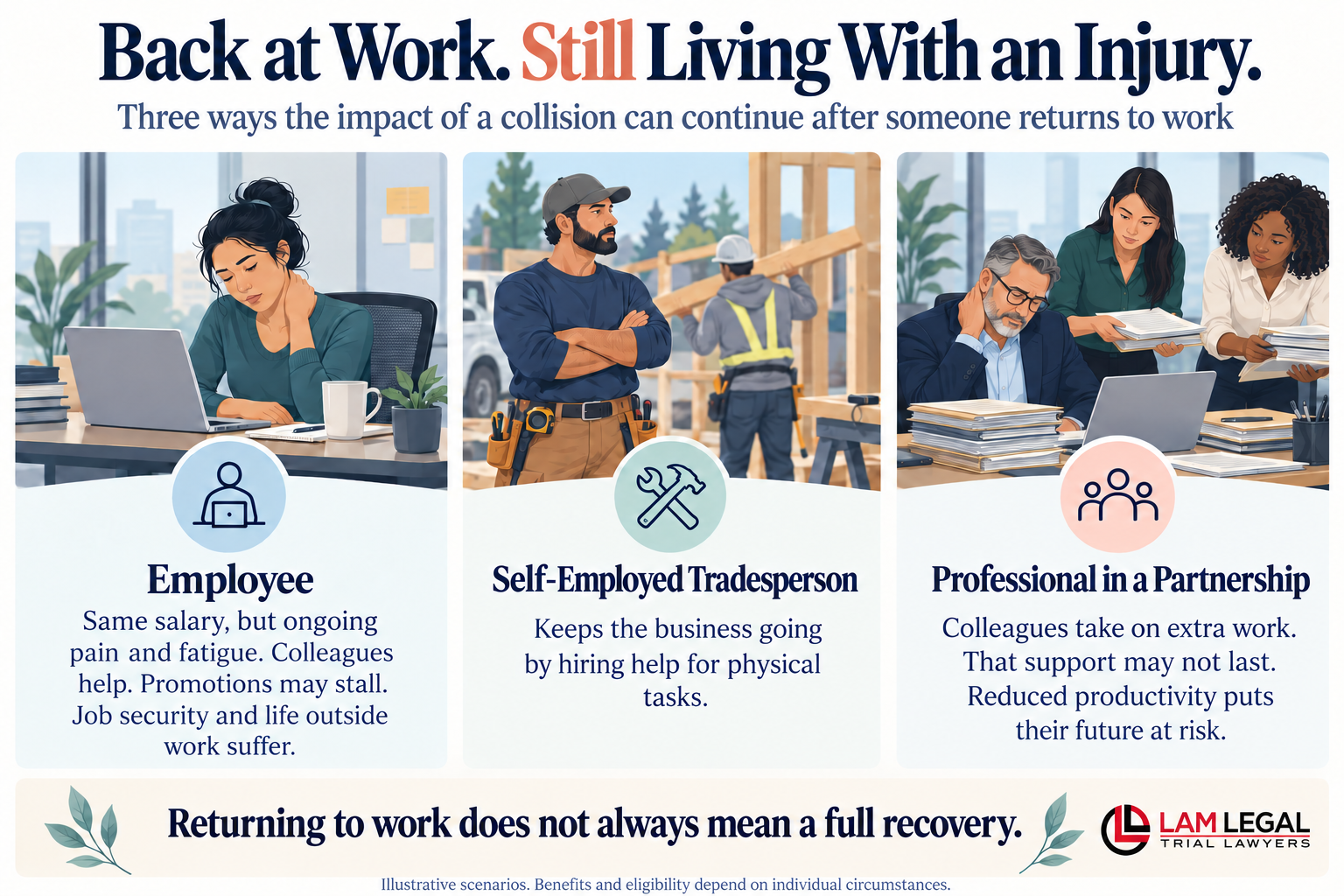
Just because someone returns to work doesn’t mean they’ve fully recovered. Consider these three hypothetical situations.
1. An Employee Who Keeps Their Salary
An employee returns to the same job after a car crash and continues earning the same salary. On paper, nothing has actually changed financially.
But persistent pain and fatigue make everyday tasks take longer. Getting through the workday leaves them too exhausted to cook, clean or spend time with family and friends. Keeping their job may come at the expense of much of their personal life.
They may be managing only because colleagues who have known them for years are taking on extra work. That goodwill may not last forever. Reduced productivity could mean missed promotions or eventual job loss. Could they find another position that pays the same? Would a new employer offer the same support?
Just because someone earns the same salary doesn’t mean they’ve recovered their previous earning capacity or quality of life.
2. A Tradesperson Who Must Hire Help
A self-employed tradesperson returns to work but can no longer handle the same physically demanding jobs. To keep the business running, they hire someone to do work they previously handled themselves.
They may also have to turn down projects or give up opportunities to grow their business.
ICBC has specific income replacement rules for self-employed people. However, its benefits guide states that business losses, including the cost of hiring additional workers, aren’t covered by income replacement benefits.
That means a tradesperson could return to work and continue earning an income while facing additional business expenses because of their injuries.
3. A Professional Whose Colleagues Pick Up the Slack
Consider a professional in a partnership who returns to work after a collision but can no longer handle their previous workload.
At first, their colleagues take on some of their responsibilities. The business might hire extra staff, while the injured professional continues earning roughly the same income.
Looking at a single month’s earnings, everything might seem fine.
But over time, the situation becomes harder to sustain. The professional is billing fewer hours, staffing costs are rising, and their colleagues are taking on more work.
What happens if their partners eventually decide they can’t keep making these arrangements?
By then, the injured professional may have missed years of career opportunities and face a much less secure financial future.
These examples don’t necessarily tell us what someone would receive under ICBC’s current rules. That depends on their injuries, medical evidence, employment circumstances and eligibility for benefits.
But here’s the point I’m trying to make: Returning to work doesn’t necessarily mean someone has fully recovered, financially or otherwise.
Why the Catastrophic-Injury Threshold Matters
The Conservatives’ proposal appears to offer additional legal protections to people with catastrophic injuries. But injuries aren’t always easy to divide into two categories.
Someone who is paralyzed or has a severe brain injury may need lifelong care. But what about someone who can still live independently and hold down a job while dealing with chronic pain, limited mobility or a permanent loss of physical ability?
These injuries can have a lasting impact on someone’s career, family life and financial future, even if they aren’t considered catastrophic.
If the government plans to offer additional legal options only to people with the most severe injuries, it needs to explain what happens to everyone else.
Just because someone can still work doesn’t mean they’ve fully recovered. Any changes to the system should take into account how injuries affect people over the long term.
What Might Meaningful Reform Look Like?
I believe British Columbia should keep public auto insurance affordable and make sure injured people have access to the care they need. But we should also look at whether the current system does enough for people living with permanent injuries.
That could mean improving existing benefits, making independent legal advice more accessible, or allowing injured people to go to court in certain situations. People can already bring certain benefit disputes to the Civil Resolution Tribunal, but we should also ask how easily an injured person can navigate that process. Reform could involve a combination of these changes.
Of course, every option comes with trade-offs. Allowing more lawsuits could increase costs and put pressure on insurance premiums. But if the system doesn’t adequately recognize permanent injuries and their long-term effects, injured people and their families may end up paying the price.
Before moving ahead, the government should explain who would qualify for additional protections, what those protections would include and how much the changes might cost.
Affordable auto insurance matters. But so does treating people with permanent injuries fairly.
The Question That Should Guide Reform
ICBC’s current no-fault model already provides important benefits, and the Conservatives’ proposal could offer additional protections to some injured people. But we need to see the details before knowing how much difference these changes would make.
As the government develops its legislation, it should pay particular attention to people who return to work but continue living with permanent injuries. Some of their losses may not become apparent until years later, and they won’t necessarily show up on a paycheque.
The question I keep coming back to is this: What happens when someone returns to work after a crash but never regains the same ability to work or enjoy life?
That’s a question any serious reform of BC’s auto insurance system needs to answer.
Ada P. Lam is the principal lawyer at Lam Legal – Trial Lawyers. Her experience includes personal injury, negligence and insurance litigation.