

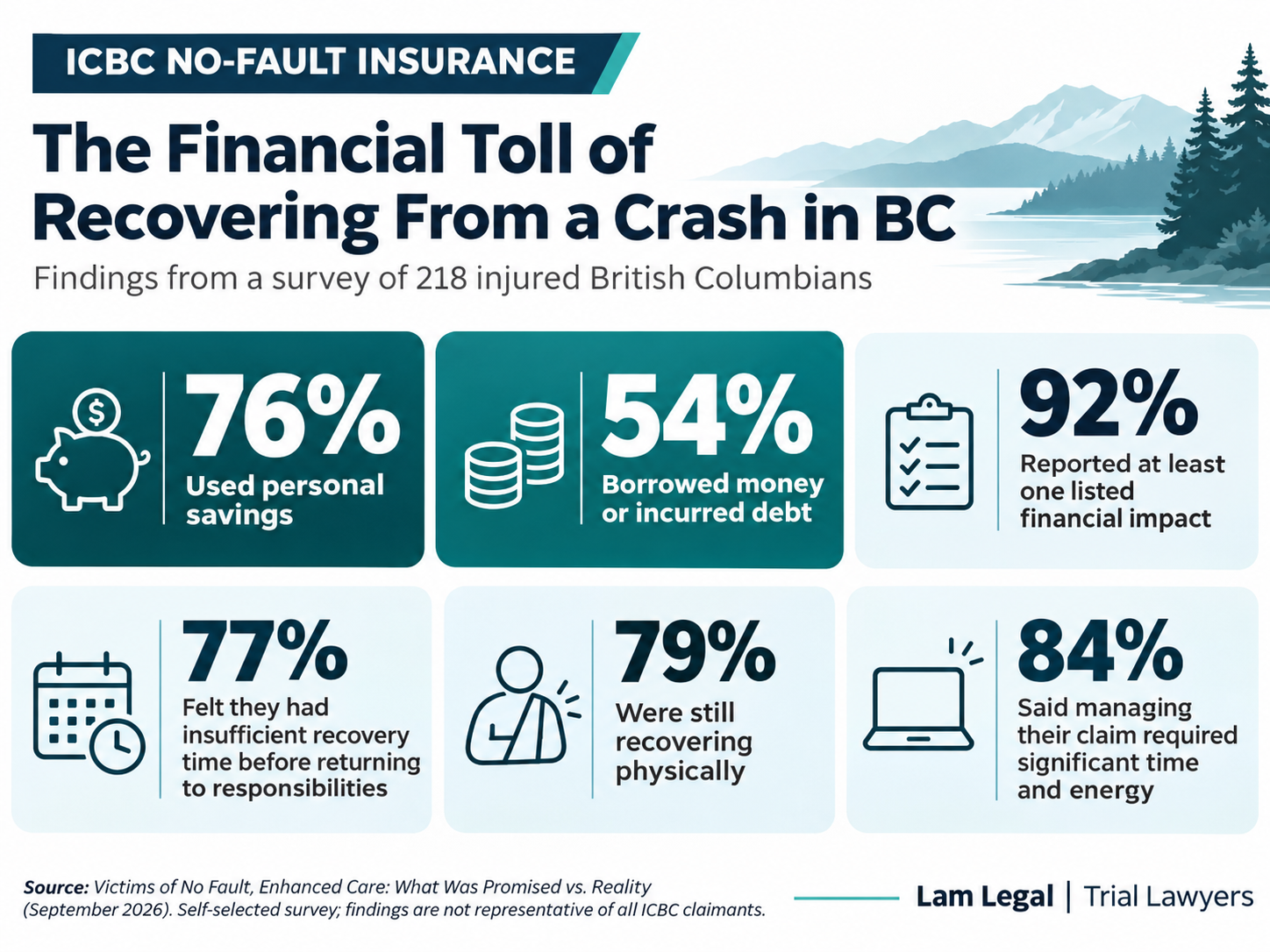
With 76% of surveyed BC crash survivors reporting that they used personal savings, advocates and legal professionals are raising questions about how the proposed reforms will address the financial consequences of serious injuries.
by Lam Legal – Trial Lawyers
If you’ve been injured in a motor vehicle accident in British Columbia, you may be wondering whether the BC Conservatives’ proposed ICBC reforms will change your rights, improve your benefits or allow you to pursue additional compensation.
Many details remain unresolved. In the meantime, crash survivors, researchers and legal professionals are highlighting issues they believe the new system needs to address.
Among them is Julia Kwan, founder of Victims of No Fault. Her research involving 218 injured British Columbians highlights the financial difficulties experienced by respondents under ICBC’s Enhanced Care model.
Vancouver litigation lawyer Ada P. Lam has also raised concerns about the proposed reforms. A former personal injury lawyer, she questions whether the new system will adequately recognize the long-term financial consequences of permanent injuries and provide fair compensation.
Here’s what we know about the proposed changes, why these concerns matter and what you can do in the meantime.
How Does the ICBC No-Fault Insurance System Currently Work?
The Insurance Corporation of British Columbia (ICBC) introduced its Enhanced Care insurance model in May 2021. This significantly changed how injured British Columbians receive compensation after a motor vehicle accident.
Under the current no fault system:
- Drivers, passengers, motorcycle riders, cyclists and pedestrians can qualify for accident benefits regardless of who caused the crash.
- Eligible injured people who are unable to work can receive income replacement benefits of up to 90% of their net income. These benefits are subject to an annual gross income ceiling of $122,500.
- Certain treatments, including physiotherapy and massage therapy, are pre-approved for the first 12 weeks after a crash without requiring a doctor’s referral. Additional treatment may be approved if recovery takes longer.
- There is no overall lifetime dollar cap on eligible medical care and recovery benefits. However, individual benefits may be subject to specific limits.
- People who sustain qualifying permanent impairments may receive lump-sum compensation based on prescribed impairment ratings.
No-fault insurance does not mean that fault is irrelevant. ICBC continues to investigate crashes and determine responsibility, which can affect insurance premiums and vehicle damage coverage.
The transition to Enhanced Care was intended to reduce legal costs, expedite the claims process and lower insurance premiums. It also aimed to provide injured people with more immediate access to treatment. According to ICBC, customers with full Basic and Optional personal auto insurance coverage saved an average of approximately 28% during the first year.
However, under ICBC’s no-fault insurance system, you generally cannot sue the at-fault driver for personal injury compensation. Limited exceptions exist, such as when the at-fault driver is convicted of certain criminal offences, including impaired driving.
This restriction is particularly relevant to the debate surrounding the BC Conservatives’ ICBC reform proposals.
What Changes Are the BC Conservatives Proposing for ICBC?
BC’s Conservative government has proposed retaining ICBC as a public insurance option and preserving no-fault coverage for most claims. However, catastrophically injured people would have greater access to legal representation.
This direction was reiterated in the provincial cabinet mandate letters announced in November 2026.
For injured British Columbians, several important questions remain unanswered:
- How will catastrophic injuries be defined?
- Will eligible crash survivors regain the right to take legal action for damages?
- Will compensation account for lost future earning potential?
- What additional protections will be available to people with serious injuries who do not meet the catastrophic injury threshold?
- Will the changes apply to people with existing ICBC claims?
Access to legal representation does not automatically mean access to additional compensation. Until the government introduces detailed legislation, the full implications of the BC Conservatives’ ICBC reform plan remain uncertain.
Why Are Crash Survivors Calling for ICBC No-Fault Insurance Reform?
In September 2026, Julia Kwan published Enhanced Care: What Was Promised vs. Reality. The report examines the experiences of people injured under ICBC’s no-fault insurance system.
A crash survivor herself, Kwan has been documenting the experiences of other injured British Columbians. She encourages them to share their stories and bringing their concerns to policymakers. She also presented her research to the legislative committee reviewing BC’s auto insurance system before the review was interrupted by the provincial election.
Her research highlights the difficulties some injured people experience even when they receive insurance benefits.
Among the 218 respondents:
- 92% reported at least one listed financial impact.
- 76% used personal savings.
- 54% borrowed money or incurred debt.
- 77% felt they were not given enough time to recover before returning to work and other responsibilities.
- 79% were still recovering physically.
- 84% said managing their claim required significant time and energy.
Respondents were recruited primarily through a Trial Lawyers Association of BC email list, as well as through social media groups, posts and paid advertising.
Because participants were self-selected, the survey cannot establish how widespread these experiences are among all ICBC claimants. However, the findings identify issues that warrant closer examination as the province develops its reforms.
One of the most important questions is whether returning to work provides an accurate picture of someone’s financial recovery. Injured people may return to work in order to support their family, pay down debt or cover everyday living expenses, even when they are still recovering.
Will the Proposed ICBC Reforms Address Long-Term Financial Losses?
For Vancouver litigation lawyer Ada P. Lam, the financial difficulties documented in Kwan’s research raise questions about how the insurance system recognizes the economic consequences of permanent injuries.
“Returning to work doesn’t necessarily mean someone has fully recovered, financially or otherwise,” says Lam, principal lawyer at Lam Legal and a former personal injury lawyer.
Under ICBC’s no-fault system, injured people generally cannot pursue traditional lump-sum personal injury settlements through litigation. However, Enhanced Care provides lump-sum compensation for qualifying permanent impairments under the Insurance (Vehicle) Act. The amount is determined according to prescribed impairment ratings and statutory rules rather than an individualized assessment of all financial losses resulting from the injury.
Although Enhanced Care provides lump-sum compensation for qualifying permanent impairments under the Insurance (Vehicle) Act, the amount is determined according to prescribed impairment ratings and statutory rules.
Two people with similar permanent impairments may experience very different financial consequences depending on their occupation, career prospects and business responsibilities.
Questions about the extent of an injury, a person’s ability to work and the benefits they are entitled to receive from an insurer are also familiar to lawyers handling other types of insurance disputes, including long-term disability insurance claims.
Consider the following three hypothetical scenarios.
1. You return to work but lose opportunities for career advancement
Imagine returning to your previous job after an accident. You earn the same salary, but chronic pain or fatigue makes it difficult to work overtime, take on additional responsibilities or pursue a promotion.
You may choose to remain in your current position because your injuries make a more demanding role difficult to manage.
Although your immediate income remains unchanged, your future earning potential could be reduced.
Over the course of a career, missed opportunities for advancement could have considerable financial consequences.
2. You run a business but need to hire additional help
For self-employed people and business owners, the financial consequences of an injury can be particularly difficult to measure.
“A self-employed person might be back at work and earning money, but they could also be paying someone else to do work they previously handled themselves,” says Lam. “Their income alone doesn’t tell us what the injury has cost them.”
A self-employed tradesperson, for example, may need to hire an additional worker to perform physically demanding tasks.
The business may continue generating the same revenue, but its operating costs have increased, reducing its profitability.
3. Your injuries limit your ability to grow your career or business
Consider a professional working toward partnership in an accounting, engineering or law firm.
Following an accident, they may still be able to perform their existing duties. However, their injuries could limit their ability to attract new clients, take on complex assignments or meet the demands of a more senior position.
A business owner may face similar challenges if their injuries prevent them from expanding operations or pursuing new business opportunities.
These potential losses are more difficult to quantify because they concern income that might have been earned in the future. The financial impact will vary from case to case.
Whether the proposed ICBC reforms will provide additional ways to recognize these losses remains an important question.
What If Your Injuries Are Serious but Not Considered Catastrophic?
Much of the discussion surrounding the BC Conservatives’ ICBC reform plan has focused on catastrophically injured people.
However, under BC’s existing Permanent Impairment Regulation, catastrophic injury has a specific legal definition.
An injury can permanently change someone’s life without meeting that definition.
Someone may experience chronic pain, reduced mobility, cognitive difficulties or other permanent limitations while remaining capable of working and living independently.
Lam previously examined this issue in her article, BC Conservatives’ ICBC No-Fault Insurance Plan Raises Questions About Permanent Injuries.
“There are people who can still live independently and hold down a job but whose injuries have permanently changed what they can do. We need to consider how the proposed reforms would affect those people as well,” says Lam.
If the new system retains a similarly restrictive definition of catastrophic injury, some people experiencing substantial long-term financial losses could remain outside the scope of expanded legal remedies.
The definition of catastrophic injury under any future legislation will therefore be particularly important to crash survivors.
Will ICBC No-Fault Auto Insurance Changes Affect Existing Claims?
If you were injured in a motor vehicle accident before the proposed reforms come into effect, you may be wondering whether you will be eligible for additional compensation.
It is too early to know.
When introducing changes to an insurance system, the government may establish transitional provisions that determine which claims fall under the previous rules and which are governed by the new legislation.
These provisions could address the date of an accident, the status of an existing claim or other eligibility requirements.
Until the legislation is available, injured people should not assume that their existing claims will qualify for new benefits or legal remedies.
To protect your interests, you should continue to comply with any requirements and deadlines associated with your existing ICBC claim rather than wait for the proposed reforms.
What Can You Do While Waiting for ICBC Reform?
Whether you have recently been injured or have already returned to work, maintaining detailed records can help you understand the financial consequences of your injuries and support discussions about your existing insurance benefits.
Keeping your paperwork organized can also make it easier to communicate with ICBC and explain how your circumstances have changed since the accident.
- Lost income: Pay statements, tax returns and records of missed work, reduced hours or unpaid leave.
- Changes in work responsibilities: Document workplace accommodations, reassigned duties or tasks you can no longer perform because of your injuries.
- Additional business expenses: If you are self-employed, keep invoices and payroll records for additional workers or contractors you have needed to hire.
- Treatment and rehabilitation expenses: Keep receipts for medical appointments, medication, rehabilitation services, assistive devices and other injury-related expenses.
- Career and business opportunities: Retain correspondence or other records of specific employment, promotion or business opportunities affected by your injuries.
- Ongoing symptoms and limitations: Maintain a record of how your injuries affect your ability to work, manage your household and carry out everyday activities.
- Communication with ICBC: Keep copies of benefit decisions, correspondence, submitted documents and requests for additional information.
If you disagree with an ICBC decision, ask for the reasons in writing and find out what review or dispute resolution options are currently available. Applicable deadlines may vary depending on the nature of the dispute.
You may also wish to review any separate disability or other insurance policies you hold to understand whether additional benefits are available.
Keeping these records does not guarantee additional compensation or establish eligibility under future reforms. However, they may help you explain the impact of your injuries when discussing your claim with ICBC or seeking independent legal advice.
What Still Needs to Be Addressed in BC’s ICBC Reforms?
The research conducted by Victims of No Fault highlights the importance of collecting more comprehensive data on the financial circumstances of injured British Columbians.
The debate also has relevance beyond British Columbia. Policymakers and accident victims in provinces such as Alberta may find BC’s experience useful when examining their own approaches to auto insurance reform.
Knowing whether someone has returned to work provides useful information. Policymakers could also examine whether injured people have depleted their savings, taken on debt, incurred additional business expenses or experienced lasting reductions in their earning capacity.
More representative research could help establish how widespread these difficulties are and whether existing insurance benefits adequately address them.
Kwan’s work documenting the experiences of crash survivors and Lam’s independent legal commentary offer complementary perspectives on the financial consequences of serious injuries.
Affordable auto insurance and timely access to treatment remain important objectives. As the province develops its reforms, the question for many injured British Columbians is whether the new system will also recognize the long-term financial impact of their injuries.
Related Reading and Resources
From Lam Legal:
- BC Conservatives’ ICBC No-Fault Insurance Plan Raises Questions About Permanent Injuries
- Insurance Denial and Disability Insurance Lawyers in Vancouver
- Lam Legal Practice Areas
Additional resources:
- Victims of No Fault: Research and Advocacy
- Enhanced Care: What Was Promised vs. Reality
- ICBC: Injury Claims and Recovery
- BC Permanent Impairment Regulation
Ada P. Lam is the principal lawyer at Lam Legal, a Vancouver-based litigation law firm serving clients across British Columbia. Her experience includes complex personal injury, negligence and insurance litigation.
This article provides general information and does not constitute legal advice.