


By Lam Legal | Reviewed by Ada P. Lam
If someone breaches a contract with you, you generally have two years to start a lawsuit in British Columbia. Sounds simple enough.
But the safest approach isn’t to assume you have a full two years from the date that seems most obvious.
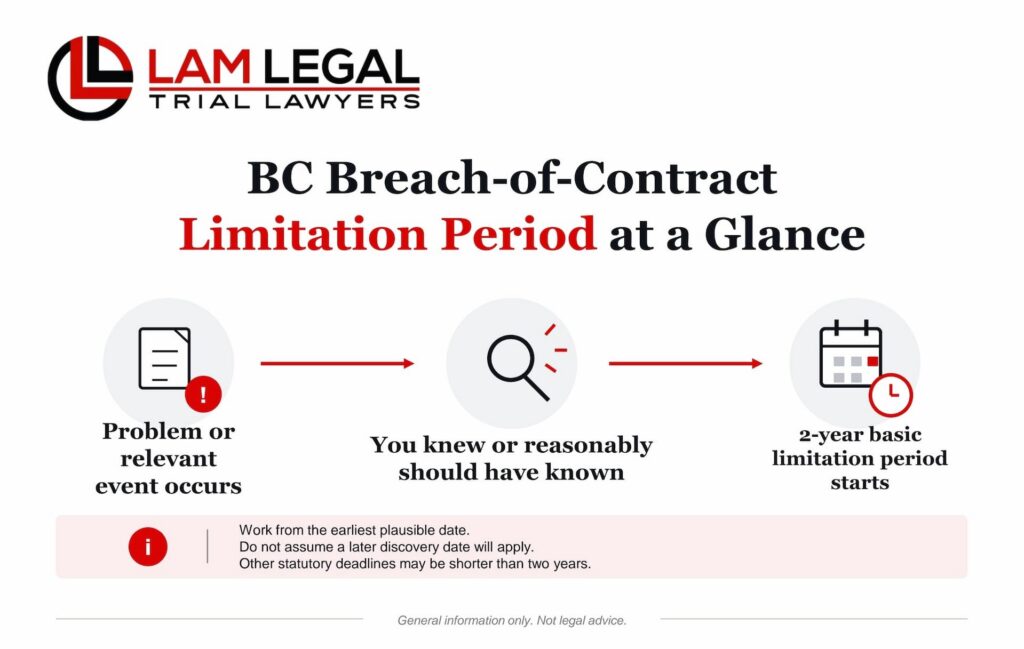
In practice, limitation deadlines are actually pretty strict. At Lam Legal, we generally identify the earliest plausible date when several events could matter. We work from that date rather than plan around the latest possible one. Waiting to see whether a later discoverability argument is available can put an otherwise valid claim at risk.
Under BC’s Limitation Act, the basic rule is that a court proceeding must be started no more than two years after the claim was discovered. The Act also contains a discoverability rule for determining when discovery occurred.
But that rule shouldn’t be treated as extra time to sue.
If there is any uncertainty about when the limitation period starts, it is worth getting legal advice early.
Breach of contract limitation period BC: what is the deadline?
For most cases involving breach of contract, the basic limitation period is two years after the day on which the claim was discovered. As a general rule, this two year basic period is the starting point for many civil claims in British Columbia.
Under the Limitation Act, a claim is generally discovered on the first day the person knew or reasonably ought to have known that:
-
an injury, loss or damage had occurred;
-
the injury, loss or damage was caused or contributed to by an act or omission;
-
the act or omission was that of the person against whom the claim is or may be made; and
-
having regard to the nature of the injury, loss or damage, a court proceeding would be an appropriate means to seek a remedy.
That’s the legal test. The big question is which date a court may ultimately accept.
For a straightforward breach, that date may be fairly obvious.
For example, if a payment was due on June 1 and was never made, June 1 may be an obvious date to investigate.
Other disputes are less clear. A contractor may finish work that appears satisfactory, with a problem becoming apparent later. A supplier may miss a contractual deadline but continue promising delivery. The parties may spend weeks trying to resolve the dispute.
The key point is that you should not assume the limitation period begins on the latest possible date.
In practice, Lam Legal takes a relatively conservative approach. We consider the earliest event that could plausibly matter when identifying the working limitation date.
If you are still trying to determine whether what happened actually amounts to a breach, Lam Legal has also explained what happens when a business contract is breached.
When does the two-year limitation period begin?
The two year limitation period is tied to discovery, but determining when discovery occurred can be highly fact-specific.
The discovery rule looks at when the claimant knew or reasonably ought to have known enough about the problem to meet the test in the Act.
In other words, the court may consider when the claimant knew or ought to have known that damage occurred, what caused it and who was responsible. It also considers when the claimant knew or ought to have known that a court proceeding would be an appropriate way to seek a remedy.
That does not mean a claimant can simply choose the date when they personally decided the situation had become serious.
Consider a business that buys equipment after the seller makes an important representation during negotiations. The equipment later turns out to be incapable of doing what was promised.
Depending on the circumstances, the dispute might involve a breach of contract claim, a misrepresentation claim, or both.
The relevant events may not all have occurred on the same date. A representation could have been made before the contract was signed. A contractual failure may happen later. The financial consequences might become apparent later still.
That is why determining when the period starts can be complicated.
When our firm reviews this kind of situation, we look at the sequence of events as a whole. This includes negotiations, when the contract was signed, when performance was due and when something first went wrong. That helps identify the earliest plausible event rather than relying on a later discoverability argument to preserve the claim.
Can negotiations give you more time?
The answer is generally no, so don’t assume negotiations will give you more time.
Businesses often try to resolve a dispute without immediately going to court. Negotiation, mediation and other approaches may make commercial sense, and there are several ways businesses may try to enforce a contract without going to court.
But ongoing negotiations do not generally stop the limitation clock.
The Limitation Act contains specific rules that can affect the deadline when the other party acknowledges liability before the applicable limitation period expires.
In many circumstances, an acknowledgement must be in writing, signed and made to the person making the claim or that person’s agent. A partial payment can also constitute an acknowledgement for a claim involving a liquidated sum. This means an amount that is fixed or can be determined.
Whether those rules apply depends on the facts.
When we assess this issue, Lam Legal looks at the actual communications, including what was said, when it was said and whether the requirements for an acknowledgement were met.
So if the other party keeps saying, “We’ll fix it,” do not assume that promise has extended your deadline.
If the limitation period could start from an earlier date, continuing negotiations without knowing your filing deadline can be risky.
What happens if you miss the two-year period?
You may lose the ability to pursue the claim in court.
Under the Limitation Act, a court proceeding in respect of a claim generally must not be commenced more than two years after discovery.
If the applicable limitation period has expired, the claim may be statute barred, meaning the defendant can rely on the missed deadline. A plaintiff with an otherwise strong claim can therefore face dismissal because the lawsuit was started too late.
There may also be costs consequences.
The practical lesson is straightforward: do not wait until the end of the two year period to work out when your deadline actually falls.
If the date is disputed, a court may ultimately need to decide whether the claimant knew or reasonably ought to have known enough for the claim to be discovered.
But having to make that argument after the deadline has passed is very different from protecting the claim before the deadline arrives.
Is there also a 15-year ultimate limitation period?
Yes. The current Act also contains an ultimate limitation period.
Generally, a court proceeding cannot be started more than 15 years after the act or omission on which the claim is based, even if another limitation period under the Act has not yet expired.
The Limitation Act sets this outside limit, subject to exceptions and special rules.
When British Columbia introduced the current Limitation Act, the general ultimate limitation period was reduced from 30 years to 15 years.
Lam Legal doesn’t rely on the 15-year ultimate limitation period when managing an ordinary contract claim. In practice, the much shorter two-year limitation period is usually the immediate concern.
There are also exceptions and special provisions. The Act contains particular rules affecting a minor, people under a disability, certain situations involving fraud or wilful concealment, and other circumstances.
Different legislation can also apply to different areas of law. Claims involving municipalities, property, estates, insurance and construction can have additional deadlines. For example, construction disputes in BC may involve builders lien deadlines as short as 45 days.
So while the Limitation Act provides the general framework, businesses should not assume every civil claim gives them two years. In fact, limitation period set out in other legislation is often significantly shorter than two years, and can be 180 days, 45 days or even 30 days after certain events.
What if the dispute started before the contract was signed?
This is another reason to look at the entire history of the transaction.
Sometimes a claim arises from statements or conduct during negotiations.
For example, someone may make a statement to persuade another person to sign a contract, and that statement may later become the basis of a misrepresentation claim.
In that situation, claims based on pre-contract statements may involve a different act, omission and date from a later breach of contract.
The damages arising from one claim might also become apparent at a different time from the loss associated with another.
That does not mean every breach of contract limitation period starts when negotiations begin.
It means a commercial dispute may contain more than one claim, and each claim may need to be considered separately.
That’s why we may start our review with the earliest relevant interaction between the parties, including discussions that occurred before the contract was signed.
A cautious limitation analysis therefore considers the earliest relevant interaction, the contract date and when obligations were due. It also examines when the alleged failure occurred, when losses became apparent and when the claimant knew or reasonably ought to have known enough to seek a remedy.
What if you’re not sure when the breach happened?
That’s common.
Commercial disputes do not always begin with one dramatic event. Sometimes the relationship deteriorates over months.
Invoices might stop being paid one by one. One party may keep promising to complete its obligations, while the other disputes what the contract actually requires. The damage might have occurred earlier than you first realized, or you may not discover the financial consequences until later.
When Lam Legal assesses a potential contract claim, we look at the full timeline rather than just the date someone first described the problem as a breach.
To work out when the limitation period starts, a lawyer may need to consider:
-
the contract and any amendments;
-
when each party was supposed to perform;
-
statements made during negotiation;
-
emails, texts and other correspondence;
-
invoices and payment records;
-
when the breach or other alleged wrong occurred;
-
when you first became aware of an injury, loss or damage;
-
what the other party told you;
-
whether liability was acknowledged; and
-
what steps the parties took to resolve the dispute.
There may be more than one claim. The nature of each claim, the events surrounding it and when it was discovered can all affect the analysis.
It’s also important to consider deadlines outside the Limitation Act. Some legislation sets much shorter notice or filing requirements.
For that reason, the ordinary two-year rule should not be treated as a universal deadline. A claim involving a municipality for example, may have as short as a 30-day notification deadline.
Don’t wait until the two years are almost up
If you think someone has breached a contract, you do not necessarily need to rush straight to court.
But you should determine your possible limitation date early.
At Lam Legal, we generally work from the earliest plausible limitation date and leave a margin for filing rather than plan around the last possible day.
Waiting can also create practical problems. There may be documents to collect, facts to investigate, parties to identify, contractual notice requirements to comply with and settlement options to explore before a lawsuit is started.
There may also be deadlines outside the Limitation Act that are shorter than two years.
Getting advice early can help you understand whether there has been a legally actionable breach, when the applicable limitation period may have begun, what losses you may be able to recover and whether litigation makes business sense.
If your business is dealing with a contract dispute in British Columbia, Lam Legal can help you assess the agreement, the potential claim and the deadlines that may apply before you decide what to do next.
Book a Free Discovery Call or call 604-800-0774 to discuss your situation with Lam Legal Trial Lawyers.
This article provides general information only and is not legal advice. Limitation periods can depend on the specific facts of a dispute, the terms of the contract and the law that applies to the claim.
Related resources on BC limitation periods
-
Limitations and deadlines from the Lawyers Indemnity Fund provides additional information and resources concerning limitation periods and other legal deadlines in British Columbia.
-
Limitations and Deadlines Quick Reference List provides examples of deadlines found across different areas of BC law.
The Quick Reference List is provided for general reference, is not exhaustive and should not be used to determine the deadline for a particular claim without legal advice.
Legal review: This article was reviewed by Ada P. Lam for legal accuracy and clarity.


