


by Lam Legal – Trial Lawyers

Are you worried that you could be disinherited by a parent, or have you already found out that you have been? In British Columbia, being left out of a will doesn’t end the matter. For an adult child in this situation, contesting a will may be an option.
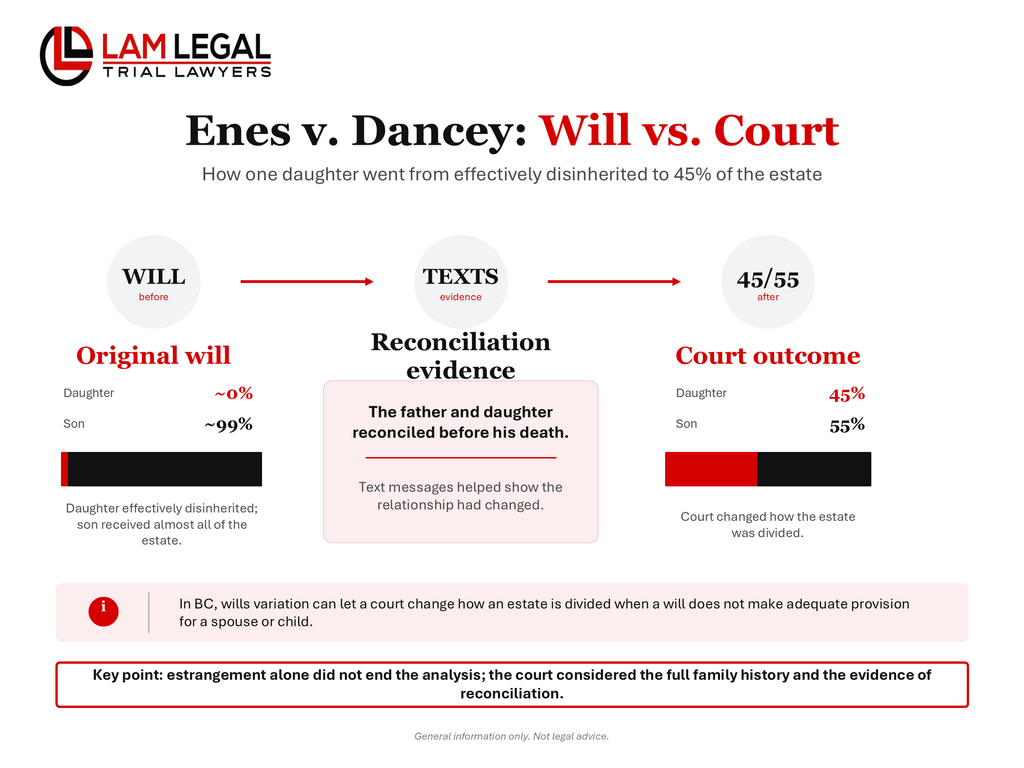
A recent BC Supreme Court decision, Enes v Dancey 2026 BCSC 1644, shows us why. The case involved a daughter who had been estranged from her father for close to a decade and was effectively left out of his will. But before he died, they reconciled.
However, the father’s will effectively left almost all of the estate to the son.
The court ultimately adjusted the will, awarding 45% of the estate to the daughter and 55% to the son. Under BC law, this is known as wills variation, where the court can change how an estate is divided if a will does not make adequate provision for a spouse or child.
Ada P. Lam, Principal Lawyer at Lam Legal Trial Lawyers, says the case shows why a long estrangement does not automatically mean disinheriting an adult child will stand.
Can you disinherit an adult child in British Columbia?
People sometimes assume that because an estate belongs to them, they can leave it to anyone they choose. In British Columbia, there’s more to it than that. Sometimes, a lot more.
As Lam explains:
“You do have a moral obligation to your spouses and children. And so as a result, even though your will may disinherit either a spouse or a child, the courts may feel differently and find that you have inadequately provided for them.”
Under BC’s Wills, Estates and Succession Act (WESA), only the spouse or children of the will-maker can bring a wills variation claim. This includes biological children and legally adopted children, including independent adult children. A spouse can include someone who lived with the deceased in a marriage-like relationship for at least two years, subject to the Act’s separation rules.
Stepchildren who were not legally adopted lack legal standing to bring a wills variation claim simply because they are stepchildren. However, they may have grounds for a different type of estate claim. Individuals with a financial interest in the estate, such as beneficiaries under an earlier will, may be able to contest a will’s validity. That interest alone does not qualify them to bring a wills variation claim.
For someone contesting a will through a wills variation claim, the will-maker’s wishes still matter. Courts also consider their moral and legal obligations when assessing adequate, just and equitable provision. A parent may owe an independent adult child a moral duty even where there was no legal obligation to support them during the parent’s lifetime.
Why do family relationships and reconciliation matter?
One of the big questions in Enes v. Dancey was whether the father’s long estrangement from his daughter was enough to justify leaving her out of the will.
Lam says it isn’t always that simple.
“Estrangement is a unique concept in that the courts do consider who caused the estrangement,” she says. “So it’s not just the fact that there is an estrangement, but whether it is objectively reasonable for a testator to have that estrangement and to disinherit based on that.”
For an estranged adult child contesting a will, this means the court can look at how the estrangement started and what was happening in the relationship.
And in this case, something important changed before the father died.
“The bigger factor is that the estrangement did end before the testator died,” Lam says. “So after drafting the will, saying that there was an estrangement and that he did not want to provide for the daughter, there was a subsequent reconciliation.”
Text messages helped show that the father and daughter were rebuilding their relationship before his death.
How to gather evidence when contesting a will
Estate litigation often requires a court to reconstruct relationships that developed over many years.
For family members contesting a will, documents created at the time can become important evidence. Evidence need not be a formal legal document.
Lam says that was particularly significant in Enes v. Dancey.
“Text messages, WhatsApp messages, those became very critical and especially in this case became extremely critical for the claimant daughter because they showed that prior to his passing, they had ended their period of estrangement and were starting to have a much closer relationship.”
Other people can also become witnesses.
Friends, relatives, grandchildren, caregivers and others may have seen what was happening within the family. The court can then assess whether their evidence is credible, consistent or potentially biased.
As Lam explains, estate litigation can involve “decades of stories and things that happen between a parent and a child.”
What factors can a court consider in estate litigation?
There’s no simple formula for deciding whether an adult child contesting a will should get more, less or nothing from an estate.
Lam says the court can look at the whole picture. That can include the relationship between the will-maker and the child, the size of the estate, what different family members contributed, the will-maker’s reasons for unequal treatment, and each person’s financial circumstances and personal situation.
Caregiving can matter too.
In Enes v. Dancey, the son had helped care for his father, and the court ultimately gave him a somewhat larger share of the estate.
But not all caregiving looks the same. A child who gives up a career, moves across the country and becomes a full-time caregiver may be in a very different position from someone who helps with rides, groceries or other day-to-day tasks.
As Lam puts it:
“We are complex creatures and our reasons for disinheriting and dealing with our family members and our relationships are going to be nuanced in various ways.”
Does this mean an estranged child will usually succeed?
No.
Lam specifically cautions against treating Enes v. Dancey as a rule that estranged adult children will usually succeed in challenging a will.
“It’s very hard to take this specific estrangement and try to generalize it to estrangements across the board,” she says, “especially where there was a reconciliation here before passing.”
Sometimes an estrangement never ends. In other situations, the reasons for disinheritance may be considered reasonable.
“Sometimes the estrangement is valid and the courts will decline to vary a will,” Lam says.
That is why the specific history of the family relationship and the available evidence matter.
The court may decline to vary the will, leaving the original distribution unchanged.
What are the grounds for contesting a will’s validity?
Wills variation concerns whether an otherwise valid will adequately provides for a spouse or child. A validity challenge concerns whether the will, or a provision in it, is legally valid.
Legal grounds for challenging a will’s validity can include lack of testamentary capacity, meaning the mental capacity required to make a will, undue influence, improper execution, fraud and forgery. Circumstances surrounding a will’s signing can raise questions of validity, particularly if undue influence is suspected. Suspicion alone does not establish that the will is invalid.
Depending on the grounds, challenges may rely on evidence such as medical records, previous wills and witness statements. Undue influence can invalidate a will or a provision if proven. Improper execution may mean a will fails to meet section 37 of WESA, although section 58 allows the court to cure certain deficiencies.
Ambiguity in a will may require the court to interpret its wording. It does not automatically make the will invalid. If a will is declared invalid, an earlier valid will may govern the estate. If there is no valid will governing the distribution, intestacy laws apply.
How can an experienced estate litigation lawyer help if you have been disinherited?
Lam says the first question is whether you actually want to challenge the will.
“It’s not always necessary to do something about it,” she says.
A wills dispute can bring up a lot of difficult family history and emotion. If you’re thinking about contesting a will, one of the first steps may be to seek legal advice from a wills and estates lawyer about the will, the reasons you were disinherited and the circumstances around it. An experienced lawyer can also explain the legal process.
To bring a wills variation claim, you must file a Notice of Civil Claim in the BC Supreme Court.
But starting court proceedings is not always the first step.
Before contesting a will in court, Lam says it may be possible to talk with the executor and other beneficiaries and try to reach a fair settlement without asking a judge to decide how the estate should be divided.
Mediation is commonly used to resolve disputes involving wills variation in BC without going to trial. Settlement remains possible even after a claim has been filed.
What does contesting a will cost?
Legal costs vary based on case complexity and duration, the lawyer’s fees and the evidence required. Costs can increase significantly if the case goes to trial. Ask for an estimate based on your circumstances before proceeding.
The losing party in a will contest may be ordered to pay costs, and costs may be awarded to the successful party. These awards generally cover only part of the actual legal expense, and the court decides the appropriate order. Estate litigation can also lead to emotional strain among family members.
How can families reduce the risk of estate disputes?
Lam says communication and documentation while the will-maker is still alive can help reduce the risk of a family member contesting a will later.
“I think documenting things while you are alive is a good method to reduce litigation,” she says.
If one child is going to receive more because they provided care, need more financial support, or already received less during the parent’s lifetime, talking about those decisions can help set expectations within the family.
Documentation matters too, especially when circumstances change.
That is one of the key lessons from Enes v. Dancey. The will was made during a period of estrangement, but the relationship later changed.
Ambiguity in a will can lead to litigation over its interpretation, and in some cases a court may construe or strike the unclear provision.
Keeping an estate plan up to date, documenting important decisions and talking openly with family members can make it much easier to understand what the will-maker intended and why.
Questions about disinheritance, wills variation or contesting a will in BC? Book a Free Discovery Call or call 604-800-0774 to discuss your situation with our law firm, Lam Legal – Trial Lawyers.
This article provides general legal information only and does not constitute legal advice. Every wills variation dispute depends on its particular facts and circumstances.